Introduction to Ecommerce SEO
In today’s digital age, ecommerce has become a cornerstone for businesses seeking to expand their reach and maximize sales. However, merely having an online presence isn’t enough; visibility is crucial. That’s where ecommerce SEO (Search Engine Optimization) comes into play. By optimizing your online store for search engines, you can enhance your visibility and attract more potential customers. This article will delve into the top ecommerce SEO strategies that can propel your online store to success.
Ecommerce SEO involves a range of techniques aimed at improving your website’s ranking on search engine results pages (SERPs). For an online store, this means more traffic, better user engagement, and ultimately, higher conversions. Given the competitive nature of the digital marketplace, mastering ecommerce SEO is no longer optional—it’s essential.
As we explore the importance of SEO for online stores, keep in mind that each strategy we discuss is a stepping stone toward achieving greater online visibility and business growth. From keyword optimization to mobile responsiveness, each aspect plays a pivotal role in crafting a successful ecommerce strategy.
Importance of SEO for Online Stores
The significance of SEO for online stores cannot be overstated. With billions of searches conducted daily, appearing on the first page of search results can dramatically impact your business’s success. SEO helps in improving your store’s visibility, making it easier for potential customers to find you amidst a sea of competitors.
Furthermore, a well-optimized ecommerce site enhances user experience by providing easy navigation, fast loading times, and mobile-friendly interfaces. This not only keeps users engaged but also increases the likelihood of conversions. Research indicates that a significant percentage of online shoppers abandon sites that load slowly or are difficult to navigate, highlighting the importance of a seamless user experience.
In addition to visibility and user experience, SEO also builds credibility. Websites that appear at the top of SERPs are often perceived as more trustworthy and authoritative. This trust translates into increased customer loyalty and repeat business, paving the way for sustained growth and success.
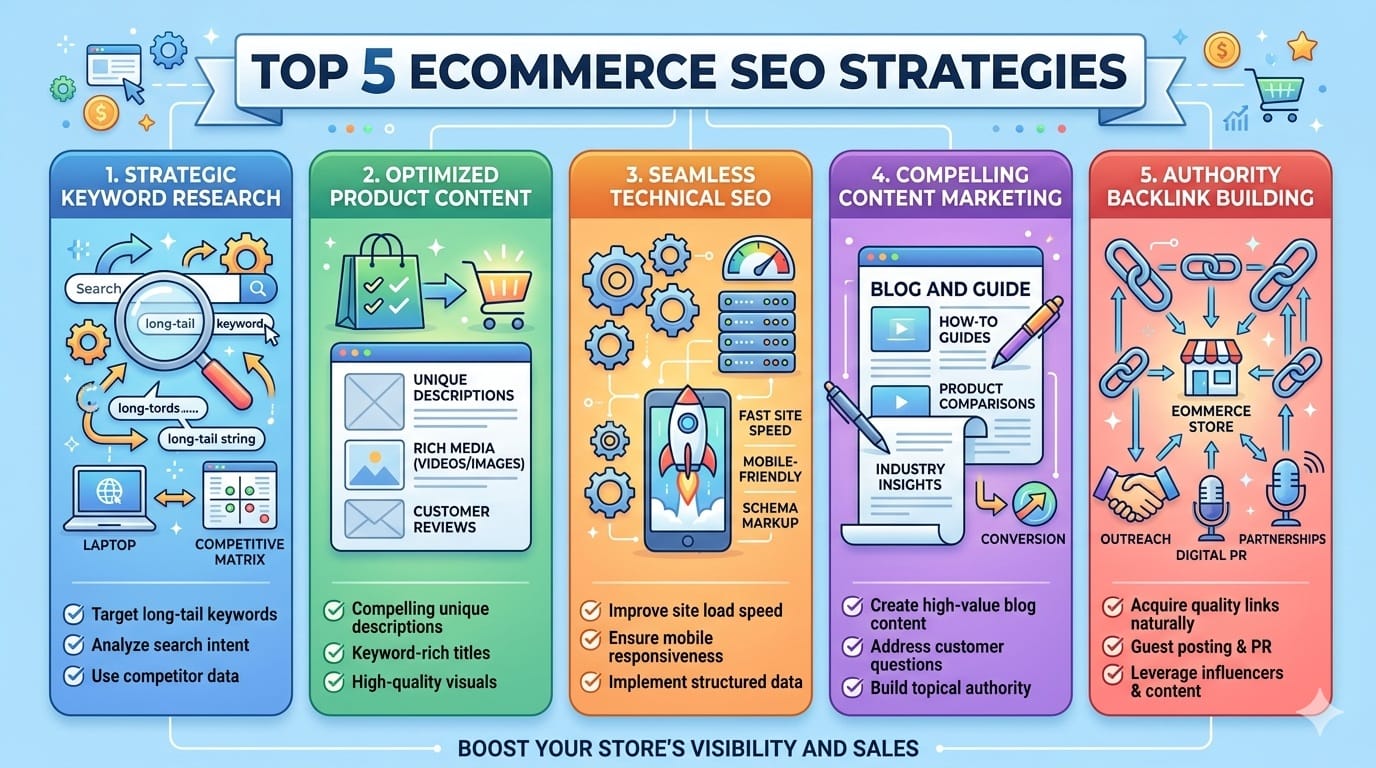
What Are the Top 5 Ecommerce SEO Strategies?
Now that we’ve established the importance of SEO for online stores, let’s delve into the top five ecommerce SEO strategies that can set your business apart. These strategies encompass a broad spectrum of techniques, each designed to enhance different aspects of your online presence.
- Keyword Optimization: Identifying and incorporating relevant keywords into your website content, product descriptions, and metadata is crucial for search engine ranking.
- High-Quality Content Creation: Consistently producing informative and engaging content helps in attracting and retaining an audience.
- Technical SEO: Ensuring your website is technically sound, with fast load times and secure connections, enhances search engine indexing and user experience.
- Mobile Optimization: With more users accessing the internet via mobile devices, ensuring your site is mobile-friendly is critical.
- Link Building: Acquiring high-quality backlinks from reputable sources boosts your site’s authority and improves search engine rankings.
These strategies, when implemented effectively, can significantly enhance your online store’s visibility and performance. Each strategy requires careful planning and execution, tailored to your specific business needs and target audience.
In-depth Analysis of Each Top Ecommerce SEO Strategy
Keyword Optimization
Keyword optimization is the foundation of any successful SEO strategy. It involves researching and selecting the right keywords that potential customers are likely to use when searching for products or services you offer. This requires a deep understanding of your target audience and market trends.
To implement effective keyword optimization, start by using tools like Google Keyword Planner or SEMrush to identify high-volume, low-competition keywords relevant to your niche. Incorporate these keywords naturally into your product descriptions, titles, and metadata. Remember, the goal is to enhance readability and relevance, not to stuff keywords unnecessarily.
Incorporating long-tail keywords is equally important. These are more specific phrases that, while having lower search volumes, often convert better due to their specific nature. By strategically using a mix of both broad and long-tail keywords, you can improve your chances of ranking higher on SERPs.
High-Quality Content Creation
Creating high-quality content is another vital strategy for ecommerce SEO. Content serves as a medium to engage your audience, convey your brand message, and establish your expertise in the industry. Blogs, articles, product guides, and how-to videos are excellent content types that can drive traffic to your site.
When crafting content, focus on providing value to your audience. Answer common questions, solve problems, and offer insights that are relevant to their needs. This not only helps in attracting visitors but also encourages them to spend more time on your site, reducing bounce rates and improving SEO metrics.
Regularly updating your content is also crucial. Search engines favor sites that consistently produce fresh, relevant content. By maintaining an active blog or news section, you can keep your audience engaged and attract new visitors, all while improving your SEO performance.
Technical SEO
Technical SEO involves optimizing the backend of your website to ensure it is easily crawlable by search engines and provides a seamless user experience. This includes improving site speed, ensuring mobile responsiveness, and implementing SSL certificates for secure connections.
Site speed is a critical factor in both user experience and SEO rankings. A slow-loading site can frustrate users and lead to higher bounce rates. Tools like Google PageSpeed Insights can help identify areas for improvement. Similarly, a mobile-friendly design is essential, given the increasing number of mobile internet users.
Secure connections, indicated by HTTPS, are also vital. Not only do they protect user data, but they also boost trust and credibility. Search engines prioritize secure sites, making SSL certificates a must-have for any ecommerce business.
Mobile Optimization
With the proliferation of smartphones, mobile optimization has become indispensable for ecommerce success. A mobile-optimized site adapts to different screen sizes, providing a smooth browsing experience across devices. This is crucial, as mobile users expect fast, easy-to-navigate sites.
Start by adopting a responsive design that adjusts to various screen sizes. Ensure that images and content are optimized for mobile, preventing slow load times. Additionally, consider implementing mobile-specific features, such as click-to-call buttons, which enhance user interaction.
Mobile optimization not only improves user experience but also boosts SEO performance. Search engines like Google use mobile-friendliness as a ranking factor, making it an essential component of any ecommerce SEO strategy.
Link Building
Link building involves acquiring high-quality backlinks from reputable websites, which enhance your site’s authority and improve search engine rankings. This strategy is crucial for establishing credibility and driving organic traffic to your online store.
To build a strong backlink profile, focus on creating valuable, shareable content that others in your industry will want to link to. Guest blogging on reputable sites, collaborating with influencers, and participating in industry forums are effective ways to earn backlinks.
Remember, quality matters more than quantity. A few high-quality backlinks from authoritative sites can have a more significant impact than numerous low-quality links. Monitor your backlink profile regularly to ensure it remains healthy and supports your SEO goals.
How to Implement SEO Strategies for Businesses in India
Implementing ecommerce SEO strategies for businesses in India requires a nuanced approach, considering the unique market dynamics and consumer behaviors. The Indian ecommerce landscape is rapidly evolving, with an increasing number of consumers turning to online shopping. This presents both opportunities and challenges for businesses.
Firstly, understanding the local market is crucial. Conduct thorough research to identify popular search terms and consumer preferences specific to India. Leverage local SEO techniques, such as optimizing for local keywords and creating location-specific landing pages, to target regional audiences effectively.
Secondly, focus on mobile optimization. India has a large mobile internet user base, making mobile-friendly sites essential for reaching a wider audience. Implement responsive designs and ensure fast load times to enhance user experience and improve SEO performance.
Finally, consider cultural nuances and language preferences. Offering content in multiple languages can broaden your reach and appeal to diverse consumer groups. By tailoring your ecommerce SEO strategies to the Indian market, you can better connect with your audience and drive business growth.
Tailoring Ecommerce SEO Strategies for Businesses in Asia
Asia’s diverse and rapidly growing ecommerce market presents unique opportunities and challenges for businesses. To succeed, it’s essential to tailor your ecommerce SEO strategies to meet the specific needs of this dynamic region.
One effective approach is to focus on localization. This involves adapting your website and content to suit the cultural and linguistic preferences of different Asian markets. Offering multilingual support and using culturally relevant imagery and messaging can help your brand resonate with local audiences.
Another critical aspect is understanding the regional search engines. While Google dominates globally, other search engines like Baidu in China and Naver in South Korea have significant market shares. Optimizing for these platforms requires a deep understanding of their algorithms and user behaviors.
Lastly, consider the technological landscape. Asia is home to some of the fastest-growing mobile and internet markets, making mobile optimization a top priority. By embracing these strategies, businesses can tap into the vast potential of the Asian ecommerce market and drive significant growth.
Case Studies: Successful Ecommerce SEO Implementations
Examining successful ecommerce SEO implementations can provide valuable insights and inspiration for your own strategies. Let’s explore a few case studies that highlight the power of effective SEO practices.
Case Study 1: An Indian Fashion Retailer
An Indian fashion retailer sought to improve its online visibility and increase sales. By focusing on keyword optimization and local SEO, the company achieved remarkable results. Implementing region-specific keywords and creating localized landing pages helped attract more traffic from targeted areas, leading to a 30% increase in organic search visits and a significant boost in sales.
Case Study 2: A Global Electronics Brand in Asia
A global electronics brand aimed to expand its presence in Asia. By tailoring its SEO strategies to local markets, including optimizing for Baidu and Naver, the brand saw a substantial increase in visibility. The company’s focus on mobile optimization and content localization further enhanced user engagement, resulting in a 40% increase in conversions within six months.
Case Study 3: An Online Home Decor Store
An online home decor store in the US leveraged high-quality content creation and link building to improve its search rankings. By producing engaging blog content and earning backlinks from reputable home design sites, the store experienced a 50% increase in organic traffic and a 25% rise in sales over a year.
These case studies demonstrate the tangible benefits of implementing well-crafted ecommerce SEO strategies. By learning from these success stories, businesses can refine their approaches and achieve similar results.
The Role of a Consultant: How Maxsdigit Can Help
For businesses seeking expert guidance, hiring an ecommerce SEO strategy consultant like Maxsdigit can be a game-changer. With years of experience and industry knowledge, Maxsdigit offers tailored solutions to help businesses navigate the complexities of ecommerce SEO.
Maxsdigit’s approach begins with a comprehensive analysis of your current SEO performance. This includes identifying strengths, weaknesses, and opportunities for improvement. Based on these insights, Maxsdigit crafts a customized SEO strategy that aligns with your business goals and target audience.
Moreover, Maxsdigit provides ongoing support to ensure your SEO efforts remain effective and up-to-date. From technical SEO enhancements to content creation and link building, Maxsdigit covers all aspects of ecommerce SEO. By partnering with Maxsdigit, businesses can unlock their full potential and achieve lasting success in the competitive online marketplace.
Common Mistakes to Avoid in Ecommerce SEO
While implementing ecommerce SEO strategies, it’s crucial to avoid common pitfalls that can hinder your success. Let’s explore some mistakes to steer clear of and ensure your efforts yield the desired results.
- Keyword Stuffing: Overloading your content with keywords can harm readability and result in search engine penalties. Focus on natural, relevant keyword usage.
- Ignoring Mobile Optimization: Failing to optimize for mobile can lead to high bounce rates and lost opportunities. Ensure your site is responsive and user-friendly across devices.
- Neglecting Technical SEO: Overlooking technical aspects like site speed and security can negatively impact user experience and search rankings. Regularly audit and optimize your site.
- Overlooking Local SEO: For businesses targeting regional audiences, neglecting local SEO techniques can result in missed opportunities. Optimize for local search terms and create location-specific content.
- Ignoring Analytics: Failing to monitor and analyze your SEO performance can prevent you from making informed decisions. Use tools like Google Analytics to track progress and adjust strategies accordingly.
By avoiding these common mistakes, businesses can enhance their ecommerce SEO strategies and achieve sustainable growth.
Conclusion: Achieving Success with Ecommerce SEO
In conclusion, mastering ecommerce SEO is essential for any online store aiming to achieve success in the digital marketplace. By implementing the top ecommerce SEO strategies discussed in this article, businesses can enhance their visibility, attract more customers, and drive significant growth.
From keyword optimization to mobile optimization, each strategy plays a critical role in improving your online presence and user experience. Moreover, tailoring these strategies to specific markets, such as businesses in India and Asia, can further enhance their effectiveness.
As you embark on your ecommerce SEO journey, consider the benefits of partnering with a consultant like Maxsdigit to ensure your strategies are well-executed and aligned with your goals. By avoiding common pitfalls and learning from successful case studies, you can position your online store for long-term success.
Ready to take your ecommerce SEO to the next level? Contact Maxsdigit today to explore how our tailored solutions can help you achieve your business goals.


