Understanding Enterprise SEO: An Overview
Enterprise SEO involves optimizing large-scale websites to enhance their visibility across search engines. Unlike standard SEO, it demands a more strategic approach due to the complex structure and broader scope of enterprise websites. These websites often have thousands of pages requiring meticulous attention to detail, ensuring each page is optimized without compromising on quality or relevance.
In the realm of enterprise SEO, scalability is crucial. As an organization grows, the SEO strategy must adapt, managing the increased volume of content and ensuring that new pages are correctly indexed. This involves the application of advanced tools, automation, and processes that streamline SEO tasks across the entire website.
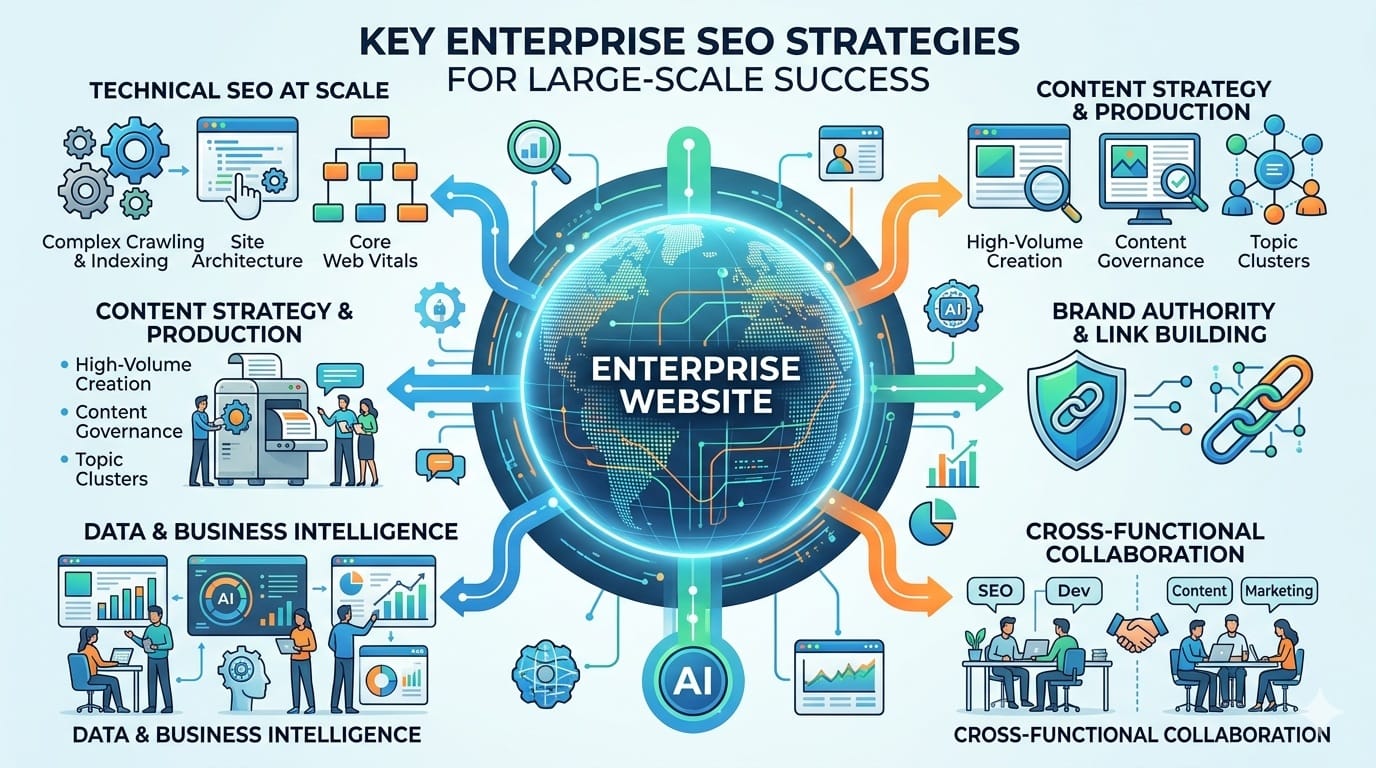
Furthermore, enterprise SEO requires collaboration across various departments, including marketing, IT, and product teams. This cross-functional collaboration ensures that SEO strategies are seamlessly integrated into the business’s broader goals, aligning with marketing campaigns and technological advancements.
The Importance of an Effective Enterprise SEO Strategy
An effective enterprise SEO strategy is vital for maintaining a competitive edge in today’s digital marketplace. It not only boosts organic search visibility but also significantly enhances brand credibility and authority. When implemented correctly, an enterprise SEO strategy can drive substantial traffic, resulting in increased conversions and revenue.
A well-structured SEO strategy also helps enterprises stay ahead of industry trends by adapting to search engine algorithm updates. This continuous adaptation ensures that the website remains optimized for both current and future SEO challenges, safeguarding the organization’s online presence.
Moreover, investing in enterprise SEO provides long-term benefits. Unlike paid marketing efforts, which may deliver immediate but short-lived results, SEO builds a sustainable foundation for ongoing organic traffic. This leads to cost efficiency and more consistent returns on investment over time.
What Are the Top 5 Enterprise SEO Strategies?
To unlock success in enterprise SEO, here are the top five strategies that you need to know:
- Comprehensive Keyword Research and Optimization: Identifying high-value keywords and integrating them naturally across your website is crucial. This involves understanding user intent and adapting content to meet those needs.
- Technical SEO Excellence: Ensure your website’s technical foundation is solid, including fast loading times, mobile optimization, and secure connections (HTTPS). Implementing structured data and optimizing for voice search can also give you a competitive edge.
- Content Strategy and Creation: Develop high-quality, informative content that answers user queries and aligns with search intent. Regularly update and refresh content to maintain relevance and authority.
- Link Building and Digital PR: Establish a robust backlink profile by earning links from reputable sources. Engage in digital PR to enhance brand visibility and authority through strategic media coverage.
- Data-Driven Decision Making: Utilize analytics to track performance, identify trends, and make informed decisions. Regularly conduct A/B testing to optimize conversion rates and user experience.
Enterprise SEO differs significantly from standard SEO because it involves managing thousands to millions of pages, complex technical infrastructures, multiple stakeholders, and often global or multi-brand considerations.
Here are the top 5 enterprise SEO strategies that drive scalable growth:
1. Technical Scalability & Core Web Vitals Optimization
At an enterprise level, small technical inefficiencies compound into massive crawl budget waste and ranking losses.
- Crawl Budget Management: Ensure search engines aren’t wasting resources on duplicate content, parameterized URLs, or low-value pages. Use
robots.txt, canonical tags, and internal linking structures to guide bots to high-value pages. - Core Web Vitals (CWV): Enterprise sites often suffer from bloat due to third-party scripts (tag managers, chatbots, ad tech). Prioritize LCP (Largest Contentful Paint), INP (Interaction to Next Paint), and CLS (Cumulative Layout Shift) by optimizing server response times, implementing lazy loading, and auditing JavaScript execution.
- Indexation Hygiene: Regularly audit for “zombie pages” (low-traffic, low-quality pages) and either improve, consolidate, or noindex them to boost overall domain authority.
2. Topic Clusters & Semantic Authority
Instead of targeting individual keywords, enterprise SEO focuses on dominating entire topic verticals to build topical authority.
- Hub-and-Spoke Model: Create comprehensive “pillar pages” that cover broad topics broadly, linked to detailed “cluster pages” that answer specific long-tail queries. This structure helps search engines understand the depth and breadth of your expertise.
- Content Gap Analysis: Use enterprise-grade tools (like Ahrefs, Semrush, or BrightEdge) to identify where competitors rank but you don’t. Prioritize content creation based on business value (revenue potential) rather than just search volume.
- E-E-A-T Enhancement: Explicitly demonstrate Experience, Expertise, Authoritativeness, and Trustworthiness. For enterprise brands, this means clear author bios, citing reputable sources, and showcasing credentials, especially in YMYL (Your Money Your Life) sectors like finance or health.
3. Automation & AI-Driven Workflows
Manual SEO is impossible at scale. Enterprise strategies rely on automation to maintain consistency and efficiency.
- Programmatic SEO: For businesses with large datasets (e.g., e-commerce product pages, location pages, job listings), use templates to generate high-quality, unique pages at scale. Ensure each page has unique value propositions to avoid thin content penalties.
- Automated Auditing: Set up continuous monitoring for broken links, 404 errors, redirect chains, and metadata issues. Tools like Screaming Frog (scheduled crawls) or enterprise platforms can alert teams to issues before they impact rankings.
- AI for Content Optimization: Use AI not to write final content, but to assist with meta description generation, internal linking suggestions, content briefs, and schema markup creation.
4. Cross-Functional Alignment & Governance
SEO in large organizations fails when it’s siloed. Success requires integration with other departments.
- DevOps & SEO Collaboration: Embed SEO requirements into the development lifecycle (SDLC). Ensure SEO checks are part of the QA process before new features or site migrations go live.
- Content & Product Teams: Align SEO keyword research with product roadmaps and content calendars. Ensure product titles, descriptions, and category structures are optimized for search intent from day one.
- Global/Local SEO Governance: For multinational enterprises, establish clear guidelines for hreflang implementation, local domain strategies (ccTLDs vs. subdirectories), and regional content adaptation to avoid cannibalization.
5. Data Integration & Revenue Attribution
Move beyond vanity metrics (traffic, rankings) to prove ROI and guide strategy.
- Connect SEO to CRM/Revenue: Integrate SEO data with Salesforce, HubSpot, or Google Analytics 4 (GA4) to track how organic search contributes to leads, conversions, and revenue. Identify which keywords drive high-value customers, not just visitors.
- Share of Voice (SOV) Tracking: Monitor your brand’s visibility compared to competitors across key topic areas. Use SOV data to justify budget allocation and identify market opportunities.
- Custom Dashboards: Build executive-level dashboards that highlight KPIs tied to business goals (e.g., organic revenue, conversion rate, customer acquisition cost) rather than just technical SEO metrics.
Key Takeaway: Enterprise SEO is less about “tricks” and more about systematic excellence. It requires a robust technical foundation, a content strategy built on authority, automated processes for scale, organizational alignment, and clear data-driven ROI measurement.
Tailoring Your Enterprise SEO Strategy in India
When crafting an enterprise SEO strategy in India, it’s essential to consider the unique market dynamics and consumer behavior. The Indian digital landscape is rapidly evolving, with a growing number of internet users and increased mobile penetration.
Local SEO plays a significant role in India. Optimizing for regional languages and dialects can help capture a broader audience. Additionally, understanding cultural nuances and integrating them into your content strategy can enhance engagement and brand affinity.
Moreover, leveraging India-specific digital platforms and social media channels can amplify your reach. Platforms like WhatsApp and regional social networks offer unique opportunities for engagement and should be incorporated into your enterprise SEO strategy.
Enterprise SEO in India requires a specialized approach that accounts for the country’s unique digital landscape: extreme mobile dominance, linguistic diversity, varying connectivity speeds, and a rapidly evolving startup ecosystem. While global enterprise principles apply, success in India hinges on hyper-localization and technical adaptation.
Here are the top 5 Enterprise SEO strategies specifically tailored for the Indian market in 2026:
1. Mobile-First & “Lite” Technical Architecture
With over 70% of Indian web traffic coming from mobile devices, Google’s mobile-first indexing is not just a guideline but a survival requirement [[40]].
- Performance on Low-Bandwidth Networks: Enterprise sites must optimize for users on 4G/3G networks in Tier 2 and Tier 3 cities. This involves aggressive image compression, minimizing JavaScript execution, and implementing Accelerated Mobile Pages (AMP) or lightweight PWA (Progressive Web App) structures to ensure fast Load Largest Contentful Paint (LCP) scores even on slower connections [[41]].
- Mobile-Only Indexing Checks: Regularly audit the mobile version of your site separately from desktop. Ensure that critical content, structured data, and internal links present on desktop are fully accessible on mobile, as Google primarily uses the mobile version for ranking [[45]].
- App Deep Linking: For enterprises with apps (common in Indian fintech, e-commerce, and edtech), implement App Indexing and deep linking to seamlessly connect app content with web search results, capturing users who prefer native apps.
2. Multilingual & Hyper-Local Content Strategy
India’s linguistic diversity means an English-only strategy misses a massive portion of the potential audience.
- Vernacular SEO: Develop dedicated content clusters in major regional languages like Hindi, Tamil, Telugu, Bengali, and Marathi. This goes beyond translation; it requires culturally relevant keyword research and content creation that resonates with local idioms and search intent [[33]].
- Hreflang Implementation: For enterprises serving multiple regions or operating globally with an Indian presence, precise
hreflangtags are critical to prevent duplicate content issues between English and regional language versions [[36]]. - Voice Search Optimization: With the rapid adoption of voice assistants in regional languages, optimize for conversational, long-tail queries in Hindi and other vernaculars. Focus on question-based content (“Kya hai,” “Kaise karein”) to capture voice search traffic [[33]].
3. Navigating Complex Site Structures & Crawl Budgets
Indian enterprise websites often suffer from “index bloat” due to years of accumulated content, dynamic parameters, and legacy structures.
- Crawl Trap Mitigation: Large Indian e-commerce and news portals frequently generate infinite spaces through filters (e.g., price, color, location). Use
robots.txtand canonical tags strictly to prevent bots from wasting crawl budget on low-value parameterized URLs [[21]]. - Consolidation of Zombie Pages: Identify and prune low-performing pages that dilute domain authority. In the competitive Indian market, consolidating thin content into comprehensive pillar pages can significantly boost rankings for high-value keywords [[21]].
- Dynamic Rendering for JS-Heavy Sites: Many Indian startups use modern JS frameworks (React, Angular). Ensure dynamic rendering or server-side rendering (SSR) is implemented so search engines can easily crawl and index content without relying solely on client-side execution, which can be inconsistent on slower networks.
4. Building Authority in a High-Competition Ecosystem
The Indian digital space is crowded, with intense competition in sectors like fintech, edtech, and e-commerce.
- E-E-A-T for YMYL Sectors: For finance, health, and legal sectors (YMYL), Google places immense weight on Experience, Expertise, Authoritativeness, and Trustworthiness. Indian enterprises must showcase local credentials, expert author bios with Indian qualifications, and cite reputable local sources to build trust [[5]].
- Digital PR & Local Backlinks: Move beyond generic directory submissions. Focus on earning backlinks from high-authority Indian publications (e.g., Economic Times, YourStory, local news hubs) and industry-specific forums. Collaborate with Indian influencers and thought leaders for content partnerships that drive authoritative links [[7]].
- Brand SERP Optimization: Manage your brand’s search engine results page actively. Ensure knowledge panels, local business listings (Google Business Profile), and rich snippets are optimized to dominate the real estate for your brand name, pushing down negative or competitor content [[6]].
5. Data-Driven Attribution & Cross-Functional Governance
Enterprise SEO in India often fails due to silos between marketing, tech, and regional teams.
- Unified Analytics for Multi-Device Users: Indian users frequently switch between mobile, desktop, and apps. Implement robust cross-device tracking in GA4 to understand the full organic journey, attributing revenue correctly rather than last-click only [[5]].
- Agile SEO Integration: Embed SEO specialists directly into product and development squads. Given the fast pace of the Indian startup ecosystem, SEO checks must be part of the sprint cycle to prevent technical debt from accumulating during rapid feature releases [[29]].
- Regional Performance Dashboards: Create custom dashboards that break down performance by region and language. This allows stakeholders to see ROI not just nationally, but specifically in high-growth markets like Pune, Hyderabad, or Jaipur, justifying localized budget allocation [[26]].
Key Takeaway for India:
Success in Indian Enterprise SEO isn’t just about scale; it’s about accessibility and relevance. You must build a technically lightweight, mobile-optimized infrastructure that serves content in the user’s native language while navigating a fiercely competitive landscape through strong local authority and agile governance.
Implementing Enterprise SEO Strategies in the Asia Pacific Region
The Asia Pacific region presents diverse opportunities and challenges for enterprise SEO. With a vast array of languages, cultures, and consumer behaviors, a one-size-fits-all approach is ineffective. Instead, localization should be at the forefront of your strategy.
It’s vital to tailor content and SEO practices to resonate with local audiences. This includes understanding regional search engine preferences, such as Baidu in China or Naver in South Korea, and optimizing accordingly. Each search engine has its own algorithmic preferences, requiring customized SEO tactics.
Furthermore, the Asia Pacific region is known for its rapid technological advancements. Staying abreast of digital trends and integrating emerging technologies, such as AI and machine learning, can significantly enhance your SEO efforts in this region.
How to Conduct a Comprehensive SEO Audit for Enterprises
Conducting a comprehensive SEO audit is integral to maintaining and improving your enterprise SEO strategy. The audit process involves evaluating various elements of your website to identify areas for improvement and ensure optimal performance.
Steps to Conduct an Effective SEO Audit:
- Technical Audit: Examine server settings, site architecture, URL structure, and identify any crawl errors or security issues.
- Content Audit: Review existing content for quality, relevance, and engagement. Identify opportunities for content updates and optimization.
- Link Audit: Analyze your backlink profile to ensure that links are from credible sources and disavow any harmful links.
Regular audits help ensure that your enterprise SEO strategy remains aligned with the latest industry standards and search engine algorithms. They provide actionable insights that can guide strategic adjustments and enhancements.
Leveraging Data Analytics for Enterprise SEO Success
Data analytics is a powerful tool in enhancing enterprise SEO strategies. By analyzing user behavior, traffic patterns, and conversion metrics, organizations can gain valuable insights into their audience and website performance.
Benefits of Data Analytics in SEO:
- Performance Tracking: Monitor keyword rankings, organic traffic, and engagement metrics to assess the effectiveness of your SEO efforts.
- User Insights: Understand user demographics, preferences, and behavior to tailor content and experiences that resonate with your audience.
- Optimization Opportunities: Identify areas for improvement, such as high bounce rates or low conversion pages, and implement targeted strategies to enhance performance.
Incorporating data-driven decision-making into your enterprise SEO strategy ensures that every action is informed and aligned with business goals, leading to more efficient and successful outcomes.
The Role of Content Marketing in Enterprise SEO
Content marketing is a cornerstone of enterprise SEO, serving as a vehicle to deliver valuable information to your audience while enhancing search engine visibility. High-quality content attracts and engages users, encouraging them to spend more time on your site and increasing the likelihood of conversion.
Key Elements of a Successful Content Marketing Strategy:
- Content Quality: Ensure that all content is well-researched, informative, and provides real value to your audience.
- SEO Integration: Integrate SEO best practices, such as keyword optimization, meta tags, and internal linking, to enhance visibility.
- Content Diversity: Utilize a variety of content formats, including blogs, videos, infographics, and podcasts, to engage different segments of your audience.
By aligning content marketing with enterprise SEO, organizations can build authority, foster trust, and drive long-term organic traffic growth.
Maxsdigit: Your Trusted Enterprise SEO Strategy Consultant
At Maxsdigit, we specialize in crafting tailored enterprise SEO strategies that drive results. Our team of experts understands the complexities of large-scale websites and offers personalized solutions that align with your business objectives.
Why Choose Maxsdigit?
- Expertise: With years of experience, we bring proven strategies and innovative solutions to the table.
- Customization: We tailor our approach to meet the unique needs of your enterprise, ensuring optimal performance.
- Results-Driven: Our focus is on delivering measurable results that enhance visibility, engagement, and conversions.
Partner with Maxsdigit to unlock the full potential of your enterprise SEO strategy and achieve sustainable growth.
Common Challenges in Enterprise SEO and How to Overcome Them
While enterprise SEO offers immense benefits, it also presents unique challenges that must be addressed to ensure success. From managing large volumes of content to staying ahead of algorithm changes, enterprises must navigate various hurdles.
Common Challenges:
- Content Management: With thousands of pages, maintaining consistency and relevance can be daunting. Implementing a content management system and automation tools can help streamline processes.
- Cross-Department Collaboration: Ensuring seamless communication and collaboration between teams is crucial. Establishing clear roles and responsibilities can facilitate effective teamwork.
- Algorithm Updates: Search engines regularly update their algorithms, impacting rankings. Staying informed and agile allows enterprises to quickly adapt and maintain their competitive edge.
By proactively addressing these challenges, organizations can enhance their enterprise SEO efforts and achieve long-term success.
Conclusion: Taking the Next Steps in Your Enterprise SEO Journey
Embarking on the enterprise SEO journey requires a strategic approach and a commitment to continuous improvement. By implementing the top strategies and overcoming challenges, you can unlock significant growth and visibility for your business.
As you navigate this journey, remember the importance of data-driven insights, effective collaboration, and staying abreast of industry trends. These elements will be instrumental in crafting a robust and adaptive SEO strategy.
If you’re ready to elevate your enterprise SEO efforts, consider partnering with experienced consultants like Maxsdigit. Together, we can achieve your digital marketing goals and drive your business forward. Are you prepared to take the next step in optimizing your enterprise’s digital presence? Contact Maxsdigit today for a personalized consultation and discover how we can help you achieve your SEO goals.


