Understanding Local SEO: An Overview
In the digital age, where the internet serves as the primary source for information, mastering local search engine optimization (SEO) is crucial for businesses aiming to attract nearby customers. Local SEO focuses on optimizing your online presence to increase traffic from location-based searches. This involves a variety of strategies that ensure your business is visible and accessible to potential customers in your vicinity.
Local SEO differs from general SEO as it targets search queries with local intent. This means optimizing your business for searches that include specific geographic locations. For instance, a search for “coffee shop near me” relies heavily on local SEO to deliver the most relevant results. By understanding the mechanisms of local search algorithms, businesses can enhance their visibility and appeal to a local audience effectively.
The key to successful local SEO lies in its ability to connect businesses with potential customers in their area. As search engines become more sophisticated, the importance of local SEO continues to grow. It is not just about being found; it’s about being found first and foremost by those who are ready to make a purchase.
The Importance of Local SEO for Businesses
Local SEO is essential for businesses of all sizes, but especially for small to medium enterprises that rely on local customers. With the rise of mobile search, consumers are increasingly looking for services and products “near me,” making the optimization of local search strategies more critical than ever.
The benefits of local SEO extend beyond visibility. It helps build your business’s credibility and trustworthiness. When your business appears in local search results consistently, it signals to potential customers that you are a reputable and established entity within the community. This credibility can lead to increased foot traffic, more inquiries, and ultimately, higher sales.
Another significant advantage of local SEO is the competitive edge it provides. By implementing effective local SEO strategies, you can outrank competitors who have not optimized their online presence for local search. This advantage can translate into increased market share and growth, as more consumers turn to your business for their needs.
Top 5 Local SEO Strategies You Need to Implement
To dominate local search results, businesses must focus on the top 5 local SEO strategies that drive success:
- Optimize Your Google My Business Listing
- Local Keyword Optimization
- Build Local Citations
- Leverage Online Reviews
- Create Locally-Focused Content
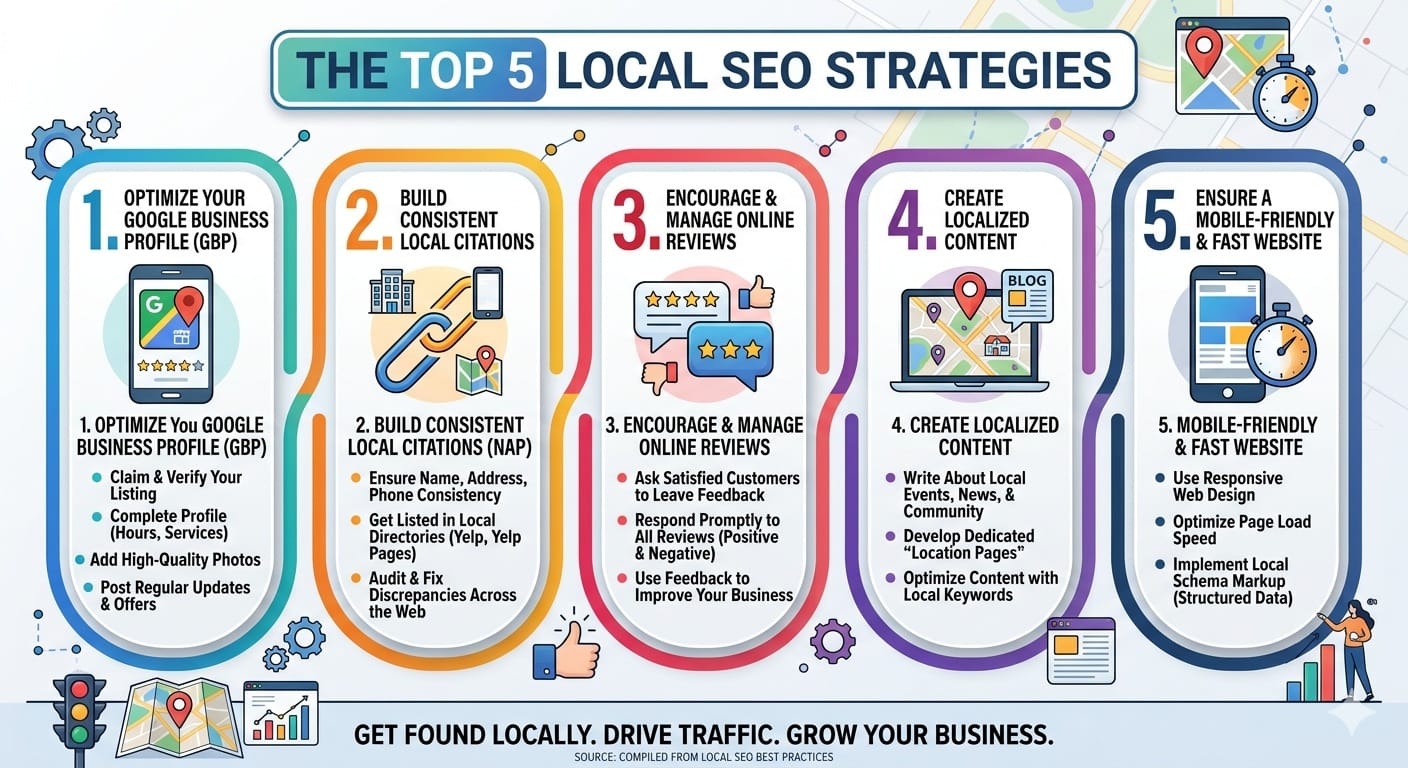
Here are the top 5 most effective Local SEO strategies to help your business rank higher in local search results and the “Map Pack”:
1. Optimize Your Google Business Profile (GBP)
This is the single most important factor for local SEO. Your GBP is what powers your appearance in Google Maps and the local 3-pack.
- Claim and Verify: Ensure you own the listing.
- Complete Every Section: Fill out every field, including hours, services, products, and attributes (e.g., “women-owned,” “wheelchair accessible”).
- Choose the Right Categories: Select a precise primary category that best describes your core business, and add relevant secondary categories.
- Add Photos Regularly: Upload high-quality photos of your team, location, and work. Listings with photos receive significantly more clicks.
- Post Updates: Use the “Posts” feature to share offers, events, or news to keep the profile active.
2. Ensure NAP Consistency Across Citations
NAP stands for Name, Address, and Phone Number. Search engines cross-reference this data across the web to verify your business’s legitimacy and location.
- Audit Your Listings: Check major directories (Yelp, Bing Places, Apple Maps, Yellow Pages) and industry-specific sites.
- Standardize Format: Ensure your business name, address format, and phone number are identical everywhere. For example, don’t use “St.” in one place and “Street” in another if possible, or ensure your database handles it consistently.
- Fix Inconsistencies: Use tools like Moz Local, BrightLocal, or Yext to find and fix inconsistent citations.
3. Generate and Manage Online Reviews
Reviews are a major ranking factor and heavily influence click-through rates.
- Ask for Reviews: Actively request reviews from satisfied customers via email, SMS, or in-person. Make it easy by providing a direct link to your GBP review page.
- Respond to All Reviews: Reply to both positive and negative reviews. This shows engagement and customer care. Responding to negative reviews professionally can mitigate damage and show potential customers you resolve issues.
- Keywords in Reviews: While you can’t control this, happy customers often mention services or locations naturally (e.g., “Best plumber in Chicago for leaky faucets“), which boosts relevance.
4. Create Location-Specific Content on Your Website
Your website needs to signal to search engines exactly where you serve and what you offer there.
- Location Pages: If you serve multiple cities, create unique, high-quality pages for each location (e.g.,
yoursite.com/plumbing-austin,yoursite.com/plumbing-round-rock). Avoid duplicate content; customize each page with local testimonials, maps, and specific service details. - Local Keywords: Incorporate local keywords naturally into title tags, meta descriptions, headers, and body content (e.g., “Best Coffee Shop in [Neighborhood Name]”).
- Embed a Map: Embed a Google Map on your contact page or footer to reinforce your location.
5. Build Local Backlinks
Backlinks from other reputable local websites signal to Google that you are a trusted authority in your community.
- Local Sponsorships: Sponsor local sports teams, charities, or events. These organizations often link to sponsors from their websites.
- Local News & Blogs: Reach out to local news outlets or bloggers for features, interviews, or press releases about newsworthy business updates.
- Chamber of Commerce: Join your local Chamber of Commerce or business associations, which usually provide a high-authority local backlink.
- Partner with Complementary Businesses: Collaborate with non-competing local businesses (e.g., a real estate agent partnering with a moving company) for cross-promotion and linking.
Bonus Tip: Mobile Optimization is critical. Most local searches happen on mobile devices (“near me” searches). Ensure your website loads quickly, is easy to navigate on small screens, and has clickable phone numbers.
Implementing these strategies can significantly enhance your local SEO efforts, ensuring that your business stands out in local search results.
Which Strategy is Most Effective for Local SEO?
When considering which strategy is most effective for local SEO, it’s important to evaluate your business goals and market conditions. While all strategies are important, optimizing your Google My Business (GMB) profile often yields the most immediate and impactful results.
Google My Business is a free tool that allows you to manage how your business appears in Google Search and Maps. A well-optimized GMB profile can improve your visibility in local search results and attract more customers. By fully utilizing this platform, you can provide potential customers with essential information about your business and enhance your online presence.
Although GMB optimization tends to be highly effective, it is crucial to integrate it with other strategies such as local keyword optimization and online reviews. A balanced approach ensures comprehensive coverage and maximizes your chances of ranking higher in local search results.
Summary: The Hierarchy of Effectiveness
| Rank | Strategy | Why It’s Critical |
|---|---|---|
| 1 | Google Business Profile | Directly controls visibility in the Map Pack (where most clicks happen). |
| 2 | Reviews & Reputation | High impact on click-through rates and trust; a key ranking signal. |
| 3 | NAP Consistency | Foundational. Without it, Google can’t trust your location data. |
| 4 | Local Content/Website SEO | Essential for ranking in organic results below the Map Pack. |
| 5 | Local Backlinks | Builds authority but takes longer to yield results. |
Bottom Line
Start with Google Business Profile. Claim it, verify it, fill it out completely, add photos, and start getting reviews. This single step will likely bring you more local customers than any other SEO effort combined. Once that is solid, focus on NAP consistency and reviews to maintain and improve your rank.
Tailoring Local SEO Strategies for Businesses in India
India’s diverse and dynamic market requires businesses to tailor their local SEO strategies to meet the unique needs of their target audience. With a rapidly growing internet user base, businesses must focus on local SEO to capture the attention of tech-savvy consumers.
One of the top 5 local SEO strategies for businesses in India is to optimize for vernacular languages. By incorporating local dialects and languages in your SEO efforts, you can reach a broader audience and cater to consumers who prefer searching in their native language. This approach not only increases accessibility but also builds trust with potential customers.
Additionally, leveraging social media platforms like WhatsApp and Instagram, which are immensely popular in India, can enhance your local SEO efforts. Engaging with customers through these channels helps build relationships and encourages user-generated content, further boosting your online visibility.
Local SEO in India has unique nuances due to the dominance of mobile usage, the specific behavior of Indian consumers, and the local digital ecosystem (including platforms beyond just Google).
Here are the top Local SEO strategies tailored specifically for businesses in India:
1. Master Your Google Business Profile (GBP) with Indian Context
While GBP is global, how you optimize it for India matters.
- Verify via Postcard/Video: Verification can sometimes be tricky in India. Ensure your business name matches your signboard exactly, as Google may ask for photo verification of your storefront.
- Use Local Language Keywords: If you serve a regional audience (e.g., Tamil Nadu, West Bengal, Maharashtra), include keywords in local languages in your business description and posts if applicable.
- Highlight “Indian” Attributes: Use attributes like “Cash on Delivery,” “UPI Accepted,” or “Halal Certified” if relevant, as these are high-intent signals for Indian users.
- Service Areas: If you are a service-based business (like AC repair or plumbing) covering multiple pin codes in a city like Mumbai or Delhi, clearly define your service areas rather than just listing one address.
2. Leverage WhatsApp Business for Engagement & Signals
WhatsApp is ubiquitous in India. While it’s not a direct ranking factor, it influences user engagement signals that Google notices.
- Add WhatsApp Link to GBP: Use the “Appointment Link” or “Website Link” in your GBP to direct users to WhatsApp Business. High click-through rates (CTR) from GBP to your contact method signal relevance.
- Quick Responses: Indian customers expect instant replies. Fast response times improve customer satisfaction, leading to better reviews and repeat business.
- Status Updates: Use WhatsApp Status to share offers. Encourage customers to save your number; this builds brand recall and direct traffic.
3. Optimize for “Near Me” & Voice Search in Hinglish/Regional Languages
Indian users frequently use voice search and mix languages (Hinglish).
- Conversational Keywords: Optimize for long-tail, conversational queries. Instead of just “Best dentist Mumbai,” target “Best dentist near me open now” or “Sasta aur accha dentist kon sa hai?” (if targeting Hindi-speaking audiences via blog content).
- Mobile-First Indexing: Most Indians access the internet via smartphones. Ensure your site loads under 3 seconds on 4G networks. Use AMP (Accelerated Mobile Pages) if possible.
- Schema Markup: Implement
LocalBusinessschema withareaServedandpriceRange(in ₹ INR) to help search engines understand your context.
4. Build Citations on Indian-Specific Directories
Global directories are important, but Indian-specific platforms carry significant weight.
- Justdial & Sulekha: These are massive local search engines in India. Claim your free listing, ensure NAP (Name, Address, Phone) consistency, and encourage reviews here. Many users still search Justdial before Google.
- Indiamart & TradeIndia: For B2B businesses, these are critical. Ensure your profile is complete and linked to your website.
- Zomato/Swiggy (For F&B): If you’re a restaurant, your presence on Zomato and Swiggy impacts local visibility. Ensure your menu, photos, and hours are updated. Google often pulls data from these platforms.
- Practo (For Healthcare): Doctors and clinics must have optimized Practo profiles, as these rank highly for medical searches.
5. Generate Reviews with Regional Authenticity
Indian consumers heavily rely on social proof, but they also look for authenticity.
- Ask for Video Reviews: Video testimonials shared on social media or embedded on your site build immense trust.
- Respond in Local Language: If a customer writes a review in Hindi, Tamil, or Marathi, respond in the same language. This shows cultural connection and boosts engagement.
- Handle Negative Reviews Gracefully: Indian customers are vocal. Address complaints publicly and politely. Offer to resolve issues offline. This demonstrates excellent customer service to potential clients.
- Incentivize Ethically: While you can’t pay for reviews, you can run contests where participants share their honest experience on Google or Justdial.
Bonus: Leverage Social Media for Local Signals
- Instagram & Facebook Geo-Tags: Always tag your location in posts and stories. Indian users heavily use Instagram for discovering local cafes, salons, and shops.
- Local Influencers: Collaborate with micro-influencers in your city. Their mentions and backlinks can drive local traffic and brand awareness.
- Google Posts in Regional Festivals: Create GBP posts around Diwali, Eid, Christmas, Pongal, etc., offering special deals. This shows activity and cultural relevance.
Key Metrics to Track for India:
- Direction Requests: How many people asked for directions to your store?
- Phone Calls: Track calls from GBP and Justdial.
- WhatsApp Clicks: Monitor how many users initiate chats via your website or GBP.
- Pin Code Performance: Use Google Analytics to see which local pin codes drive the most traffic.
By combining global best practices with India-specific platforms (Justdial, WhatsApp, Zomato) and cultural nuances (language, festivals, mobile-first behavior), you can dominate local search results in your area.
Adapting Local SEO Strategies for Businesses in the Asia Pacific
The Asia Pacific region is a melting pot of cultures, languages, and consumer behaviors, making it essential for businesses to adapt their local SEO strategies accordingly. Understanding regional differences and consumer preferences can help businesses tailor their approaches to succeed in this diverse market.
Mobile optimization is critical for businesses in the Asia Pacific, where mobile internet usage is prevalent. Ensuring that your website is mobile-friendly and loads quickly on smartphones can significantly improve your local search rankings and user experience.
Another effective strategy is to focus on local partnerships and collaborations. By partnering with local influencers, businesses can leverage their reach and authority to promote their products or services, thereby enhancing their local SEO efforts and brand recognition.
Local SEO in the Asia Pacific (APAC) region is significantly more complex than in Western markets because it is not a monolith. It is a fragmented landscape with different dominant search engines, social platforms, and consumer behaviors in each country.
A “one-size-fits-all” Google-centric strategy will fail in large parts of APAC. Here are the top strategies tailored for the diverse APAC market:
1. Adopt a “Multi-Platform” Search Strategy
While Google dominates in India, Australia, Singapore, and Japan, it is blocked or secondary in other key markets. You must optimize for the local search giants.
- China: Optimize for Baidu. This requires hosting your site on servers within China (for speed), obtaining an ICP license, and using simplified Chinese keywords. Baidu favors its own products (Baidu Maps, Baidu Baike), so presence there is critical.
- South Korea: Optimize for Naver. Naver is a portal site, not just a search engine. It prioritizes its own services like Naver Map, Naver Blog, and Naver Knowledge iN (Q&A). Creating content on Naver Blog is often more effective than traditional website SEO.
- Japan: While Google is dominant, Yahoo! Japan still holds significant share (powered by Google but with different UI/UX nuances). Also, LINE is used for search and discovery.
- Southeast Asia (Indonesia, Thailand, Vietnam): Google is dominant, but TikTok and Facebook are increasingly used as search engines for local discovery (e.g., “best cafe in Jakarta”).
2. Master “Super App” Integration
In APAC, consumers don’t just search; they transact within “Super Apps.” Your local SEO must include visibility within these ecosystems.
- Grab (SE Asia): For businesses in Singapore, Malaysia, Thailand, Vietnam, Indonesia, and Philippines, being listed on GrabFood or GrabMart is essential. Grab integrates with maps and local search.
- Gojek (Indonesia): Similar to Grab, presence on Gojek’s platform is crucial for local visibility in Indonesia.
- LINE Official Accounts (Thailand, Japan, Taiwan): Use LINE OA for local promotions. Many users search for businesses directly within LINE.
- WeChat Mini Programs (China): If you are in China, having a WeChat Mini Program is akin to having a mobile app. It’s discoverable within WeChat’s search function.
3. Hyper-Localize Content & Language
APAC is linguistically diverse. Direct translation rarely works.
- Language Nuances:
- China: Simplified Chinese.
- Taiwan/HK: Traditional Chinese.
- Japan: Japanese (with specific honorifics).
- Korea: Korean.
- Thailand/Vietnam/Indonesia: Local languages are preferred over English for local searches.
- Mobile-First & Lightweight: In emerging markets (Vietnam, Indonesia, Philippines), many users are on mid-range Android devices with data constraints. Ensure your site loads instantly on 4G. Use AMP (Accelerated Mobile Pages) where possible.
- Voice Search: With high mobile penetration, voice search is huge. Optimize for natural language queries in local languages (e.g., “Where is the nearest pho in Ho Chi Minh City?”).
4. Leverage Local Review & Directory Platforms
Global reviews (Google Reviews) matter, but local platforms carry more weight in specific countries.
- China: Dianping (the Yelp of China) is critical for restaurants and services. Meituan is also massive. Positive ratings here drive foot traffic.
- Japan: Tabelog for restaurants, Hot Pepper Beauty for salons.
- South Korea: Naver Place reviews are paramount. Koreans trust Naver reviews more than Google.
- Australia/NZ: TrueLocal and Word of Mouth alongside Google.
- Southeast Asia: Facebook Groups are powerful for local recommendations. Engage in community groups (e.g., “Expats in Bangkok,” “Jakarta Foodies”) to build local authority.
5. Build Local Backlinks & Partnerships
Authority in APAC is often built through local partnerships and media.
- Local Media Outreach: Get featured in local digital news outlets (e.g., Straits Times in Singapore, Kompas in Indonesia, Nikkei in Japan).
- Influencer Collaborations: Micro-influencers on Instagram (SE Asia, Australia), Xiaohongshu/RED (China), and Naver Blog (Korea) can drive significant local traffic and brand mentions.
- Government & Tourism Boards: If you’re in tourism/hospitality, get listed on local tourism board websites (e.g., Tourism Australia, Japan National Tourism Organization). These are high-authority local backlinks.
Country-Specific Quick Guide
| Country | Primary Search Engine | Key Local Platforms | Critical Strategy |
|---|---|---|---|
| Australia | TrueLocal, Facebook | Google Business Profile + Local Backlinks | |
| China | Baidu | WeChat, Dianping, RED | Baidu SEO + WeChat Mini Program + Dianping Reviews |
| India | Justdial, Zomato, WhatsApp | GBP + Justdial Listing + WhatsApp Integration | |
| Japan | Google, Yahoo! JP | LINE, Tabelog, Hot Pepper | GBP + LINE OA + Tabelog/Dining Listings |
| South Korea | Naver | KakaoTalk, Naver Map | Naver Place Optimization + Naver Blog Content |
| Singapore | Grab, Facebook | GBP + Grab Listings + Facebook Community Engagement | |
| Indonesia | Gojek, Tokopedia, Instagram | GBP + Gojek/GoFood Presence + Instagram Geo-tags | |
| Thailand | LINE, Wongnai (reviews) | GBP + LINE OA + Wongnai Listings |
Key Takeaway for APAC
Do not assume Google is enough.
- Identify your primary market(s).
- Map the local search ecosystem (Search Engine + Super App + Review Platform).
- Localize deeply (language, mobile experience, cultural nuances).
- Build presence on the local dominant platform (e.g., Naver in Korea, Baidu in China, Grab in SE Asia).
Success in APAC Local SEO requires a modular strategy: a core global framework (GBP, website SEO) adapted with specific local modules for each country’s unique digital landscape.
The Role of Google My Business in Local SEO
Google My Business plays a pivotal role in local SEO, acting as a bridge between businesses and potential customers. A well-managed GMB profile can enhance your online presence and improve your local search ranking, making it easier for customers to find you.
To maximize the benefits of GMB, ensure that your profile is complete and up-to-date. This includes adding accurate business information, high-quality images, and detailed descriptions of your products or services. Regularly updating your GMB profile with new content, such as posts about promotions or events, can also boost your visibility.
Furthermore, Google My Business allows you to engage with customers through reviews and Q&A. Responding to customer reviews, both positive and negative, demonstrates your commitment to customer satisfaction and can positively influence potential buyers.
Utilizing Customer Reviews and Testimonials for Local SEO Success
Customer reviews and testimonials are invaluable assets in your local SEO strategy. Positive reviews not only enhance your business’s reputation but also influence potential customers’ purchasing decisions. Encouraging satisfied customers to leave reviews can significantly boost your local search rankings.
To harness the power of reviews, create a seamless review process for your customers. This could involve sending follow-up emails after a purchase, providing direct links to your review platforms, or offering incentives for honest feedback. The more reviews you accumulate, the more credible your business appears to search engines and potential customers.
Responding to reviews is equally important. Acknowledging positive feedback and addressing any negative comments shows that you value customer input and are committed to improving your services. This level of engagement can enhance your brand image and foster customer loyalty.
How to Measure the Success of Your Local SEO Strategies
Measuring the success of your local SEO strategies is crucial to understanding their impact and making necessary adjustments. Key performance indicators (KPIs) can help evaluate the effectiveness of your efforts and guide future optimizations.
Some essential KPIs to track include:
- Local Search Rankings: Monitor your business’s position in local search results for targeted keywords.
- Website Traffic: Analyze the volume and source of traffic to determine how well your local SEO strategies are driving visitors to your site.
- Customer Engagement: Evaluate customer interactions on platforms like Google My Business and social media to gauge engagement levels.
- Conversion Rates: Measure the number of inquiries, calls, or sales generated from local searches to assess the impact on your bottom line.
Regularly reviewing these KPIs allows you to identify areas for improvement and refine your local SEO strategies for optimal performance.
Maxsdigit: Your Local SEO Strategy Consultant
Navigating the complexities of local SEO can be challenging, but with the right guidance, your business can thrive in local search results. Maxsdigit is your trusted local SEO strategy consultant, offering customized solutions to enhance your online visibility and drive local traffic.
Our team of experts understands the intricacies of local SEO and works closely with businesses to develop tailored strategies that align with their goals. From optimizing Google My Business profiles to creating locally-focused content, Maxsdigit provides comprehensive services to ensure your business stands out in local search.
Partnering with Maxsdigit means gaining access to industry insights and expertise that can elevate your local SEO efforts. Let us help you connect with your local audience and achieve sustainable growth in your market.
Conclusion: Elevating Your Business with Local SEO
In an increasingly digital world, local SEO is a powerful tool for businesses looking to reach nearby customers and boost their bottom line. By implementing the top 5 local SEO strategies, you can enhance your online presence, outshine competitors, and build a loyal customer base.
Whether you are a small business in India or a growing enterprise in the Asia Pacific, tailoring your local SEO efforts to your specific market is essential. With the support of a trusted consultant like Maxsdigit, your business can navigate the complexities of local SEO and achieve long-term success.
Take the first step towards mastering local search by optimizing your online presence today. Contact Maxsdigit to learn how we can help you elevate your business with effective local SEO strategies. Ready to take your local SEO to the next level? Contact Maxsdigit today and discover how our expert team can help you connect with local customers and grow your business. Let’s elevate your online presence and achieve success together!


